Peonza Magazine #157
CHRIS HAUGHTON (Dublin, Ireland, 1978)

Interview by Jesús Ortiz, editor
Were you read stories as a child? Did you read them yourself later? At what age did you learn to read? Back then, what did you want to be when you grew up? Did you always want to be a designer?
My parents read to us every night. I was very lucky. My mum in particular is very good with children, she had spent all her adult life working with young children before I came along. We read and played together but actually we didn’t really have that many picture books around at home. We went regularly to the library. We had Richard Scarry books at home and Mr. Men books and I had a Muppet Annual which I adored. I also vividly remember one story time at my creche we were read Dr Suess’s Green Eggs and Ham. I didn’t like it at all, I burst into tears. As I remember I thought it was nightmarish that it kept repeating the same question over and over again. When I was very young I wanted to find dinosaur bones and I would dig in the garden with a trowel. The first thing I remember wanting to be was a palaeontologist. I always liked drawing and just continued drawing all through childhood. When I was in secondary school I had decided I wanted to either be an architect or graphic designer so that I could continue to draw. I dont know the age I began to read, I enjoyed reading things like Asterix and Roald Dahl while in primary school. Until my time in university I wasn’t really all that much of a reader. I tended to like non-fiction information books. I loved DK books as a child so I am very happy to be published by them.
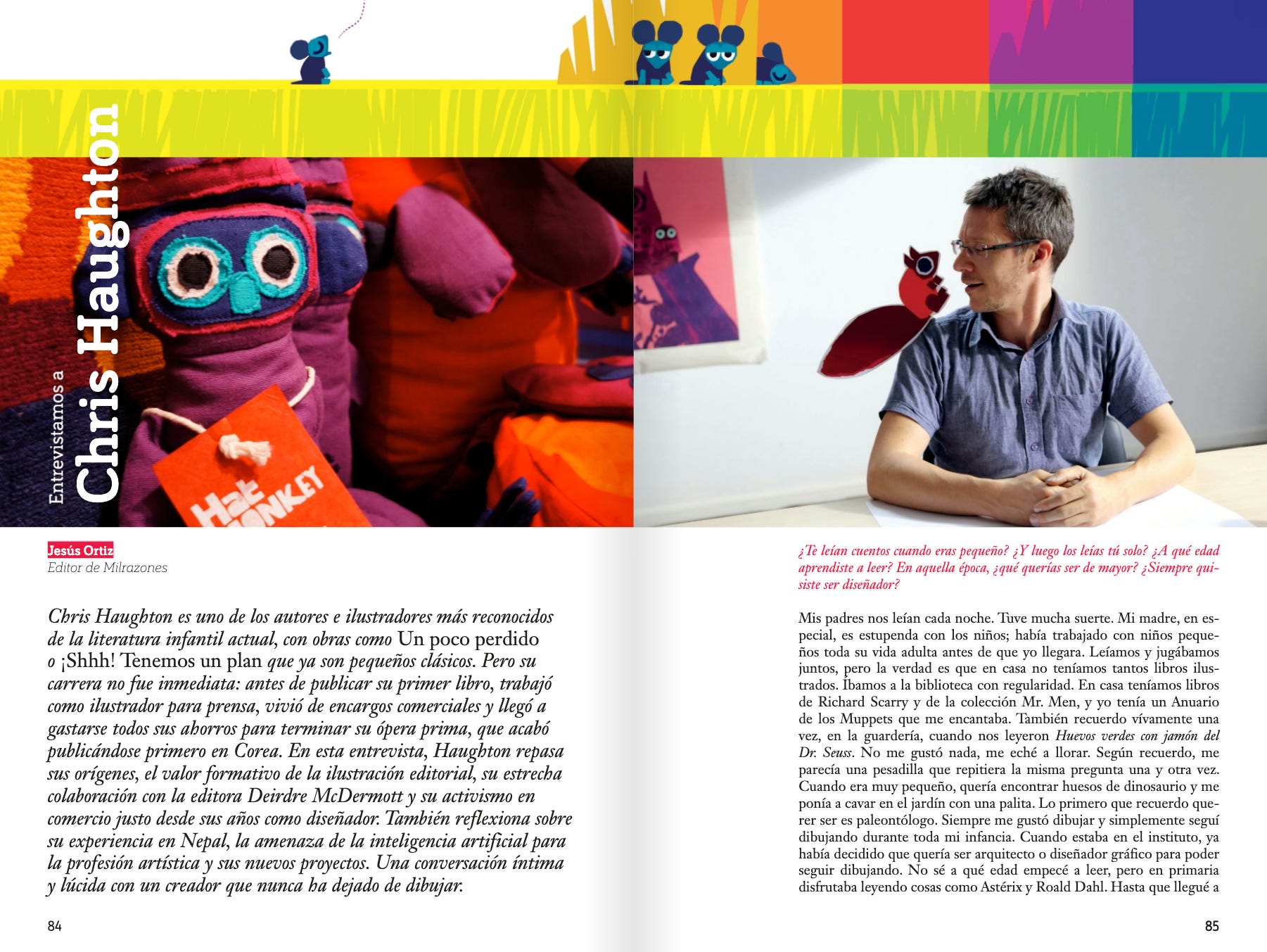
You worked as an illustrator for the opinion section of The Guardian and have spoken about the formative value of that role—having to find an image that encapsulates someone else’s thoughts in just a few hours. Did that experience shape your later creative work in any way?
Yes. I think that having to do these fast-paced editorial projects day in day out are a very good way to develop skills. It makes you think visually and doing it again and again sharpens your proficiency in visual communication. I had to do at least two or three illustrations a week to be able to pay my rent and get by. By doing this over the years I began to develop my own visual language. I dont think I could have created successful picture books without doing this groundwork first. I think they also contributed to developing my skills with words and critical thinking too. Each one is an exercise in interpretation and reinterpretation. In a sense it is translating a text into an image. And it was never a straight translation. If I disagreed with the author’s article I would try to add something of my position into the image if I could.
When did you decide to become an author? Had you always wanted to write for children? Did you have a strong knowledge of children’s literature before writing for young readers?
What made me want to pursue books was the desire to create something of my own. I was used to creating things for others with my illustrations but at some point I wanted to have more creative control and see projects through from conception to a finished piece. Picture books seemed to me to be the perfect outlet for illustration. I was really quite unaware of childrens literature when I began. I was coming at it from an illustration point of view. I was drawn to design books and illustrated books but not necessarily childrens books. It was only when I started working in publishing that I began to realise how interesting childrens books were as a form. I only later began to appreciate the craft that went into the writing and stories.
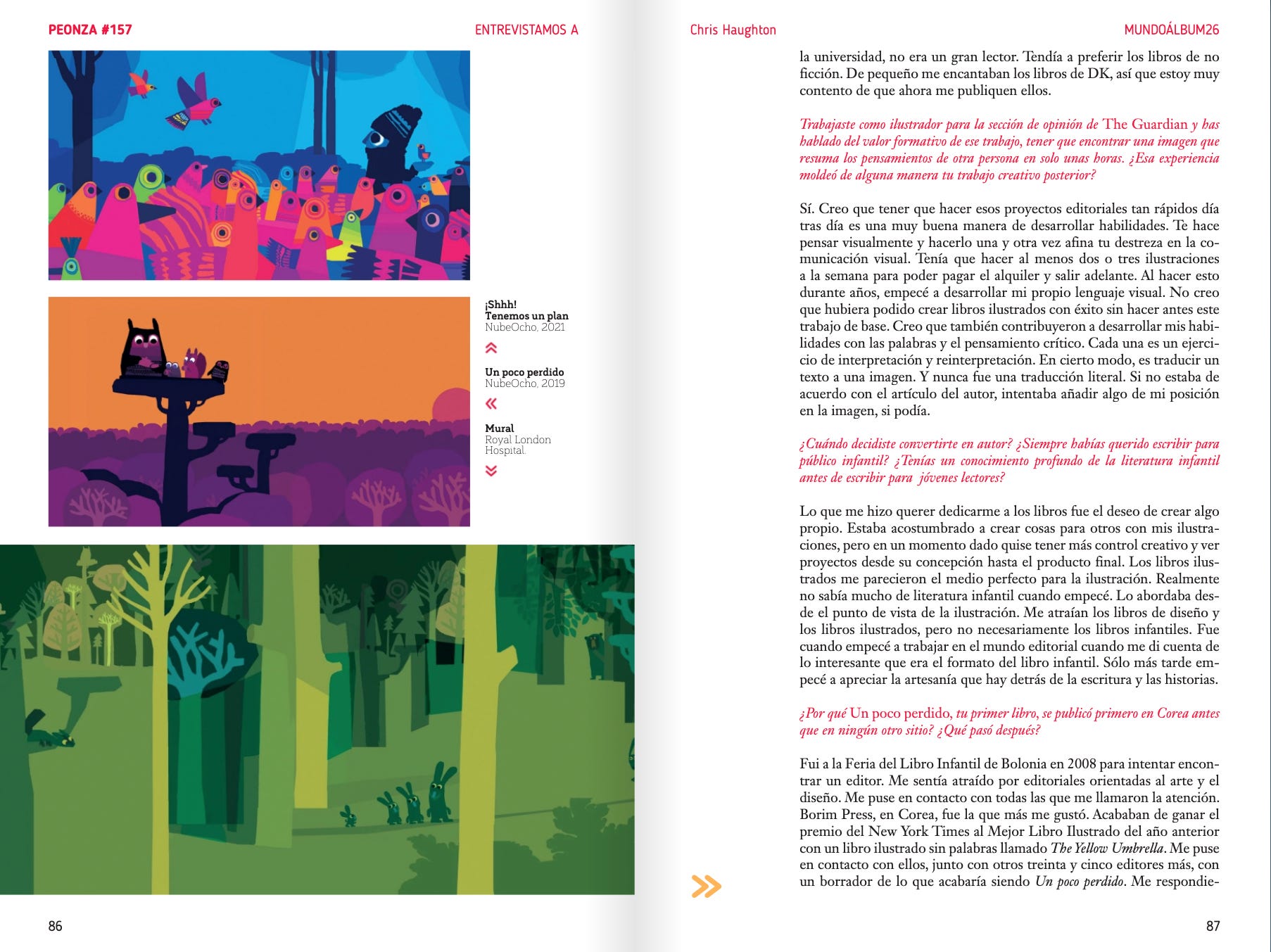
Why was A Bit Lost, your first book, published in Korea before anywhere else? What happened afterward?
I went to the Bologna Childrens Book Fair in 2008 to try to find a publisher. I was drawn to publishers that were art and design led. I contacted all the publishers that caught my eye. Borim Press in Korea stood out for me. They had just won the New York Times Best Illustrated Picture Book the year before with a wordless picture book called ‘The Yellow Umbrella’. I contacted them, alongside about thirty five other publishers with a draft of what became A Bit Lost. They got back to me soon after and after a video call offered to publish it. They were very generous and brought me over to Korea to finish the book. I ended up staying there for five months! It was published in Korean in 2009. But they were unable to find publishers to translate it. They went to Bologna and Frankfurt with it but there was no interest from foreign publishers. The following year I went to Bologna myself again, this time with a box of the korean books and tried to find publishers who were interested in translating it. That is when I met my english publisher Walker Books. It was finally published in english in 2010.
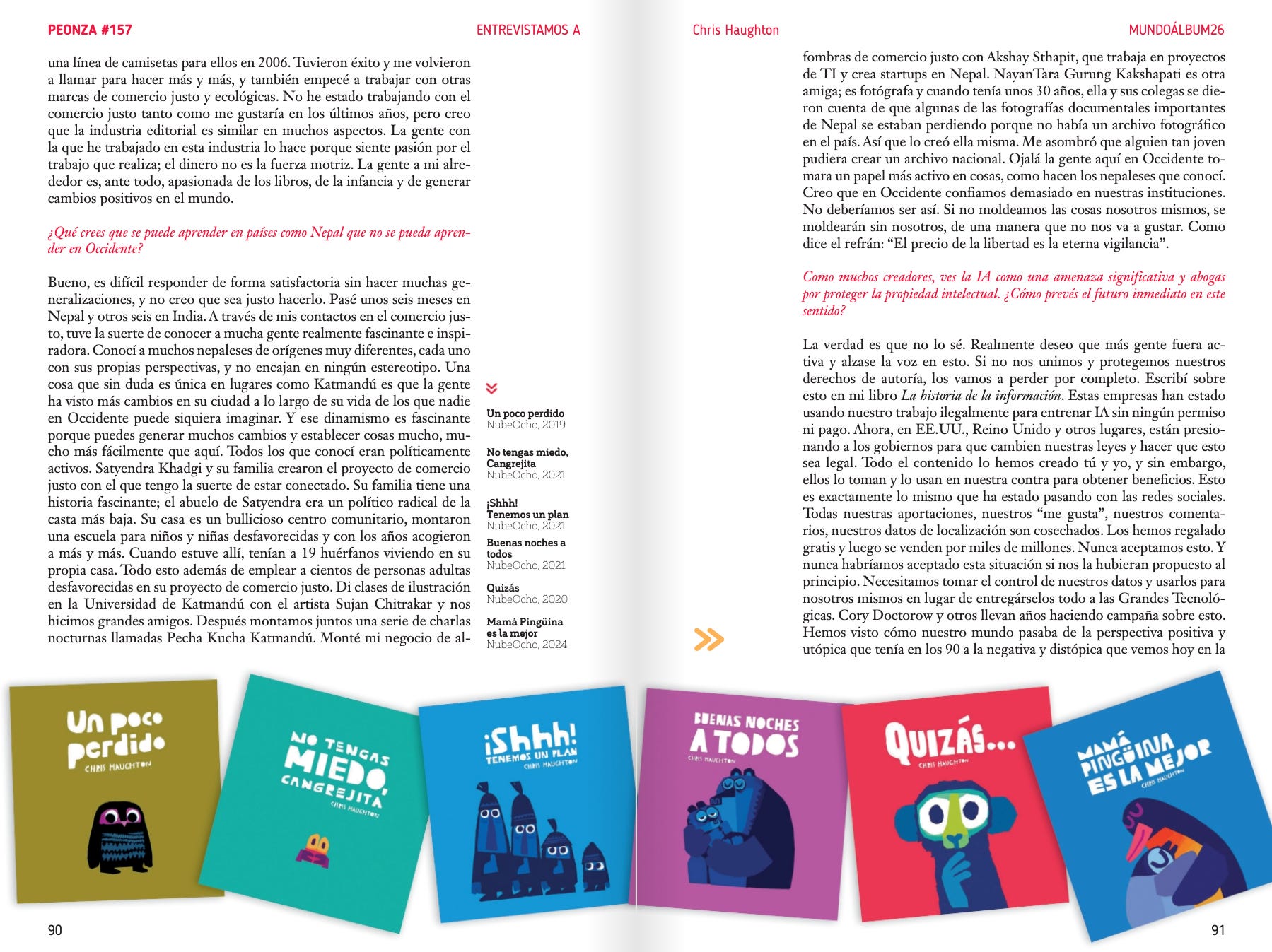
A Bit Lost was an instant, global success. How did that change your life? Your subsequent titles achieved similar acclaim, to the point where you’d become a “classic” before turning 40—a rare feat. Surely this brought advantages, but what challenges did it also present?
It wasn’t quite instant. I had taken a year off from my commercial illustration work to spend time to work on it for most of 2008 and had spent literally all my savings trying to finish it to a standard I was happy with. I tried to go straight back to doing commercial work after that but it was more difficult to re-establish after such a long break, and also the 2008 financial crisis had hit just as i was finishing the book which made it difficult to find work. It was published in Korean first in 2009 but it took years to take hold elsewhere. Money was quite tight for quite a while and at one point I was back looking for a job. It won awards when it came out in English, and elsewhere, but it still took a good while to really get out there. But I’m very lucky. Its been so satisfying to see it and the other books travel the world. I had already felt very lucky and privileged to be a full time illustrator even before the book was published. I had never thought that was even possible. But I am even luckier to be able to make a living as an author working on my own projects. I am extremely lucky and very, very grateful. I dont see any downsides to it.
Once, your British editor mentioned that you’d met 60 times to revise Shh! We Have a Plan, a book of just over 40 pages. Do editors really play such a pivotal role in shaping a book?
Im not sure that is correct. Shh! We have a Plan was actually a relatively straightforward book. Like the other books it took around two years to make. I try to meet up with my editor and art director Deirdre McDermott about every two or three weeks on average I suppose. So it was probably something like 20 or 30 meetings. Goodnight Everyone and Don’t Worry Little Crab were more tricky to make but still we wouldn’t have met anything like sixty times. I think what you might be referring to is Don’t worry, Little Crab which I kept changing and the final version was named ‘Version67b’ When I finally sent that through Deirdre thought it was hilarious. I think at one point she also said it was the most tortuous books she has worked on. She has plenty of stories about tortuous books so I think thats quite an achievement on my part.
She also jokes that Shh! We have a Plan only has 103 words and it took me two years to write so I was writing one word a week. I have to say I really appreciate Deirdre as an editor. We dont always agree but she always makes insightful points that make me rethink things. Its so important to have someone you trust to bounce things off. These books are not made alone. They are collaborations.
Beyond writing and illustrating, you’re deeply engaged in activism—supporting fair trade and founding initiatives to employ women in underserved countries. Do you see this as a duty for any decent person, or do you believe children’s authors carry added responsibilities?
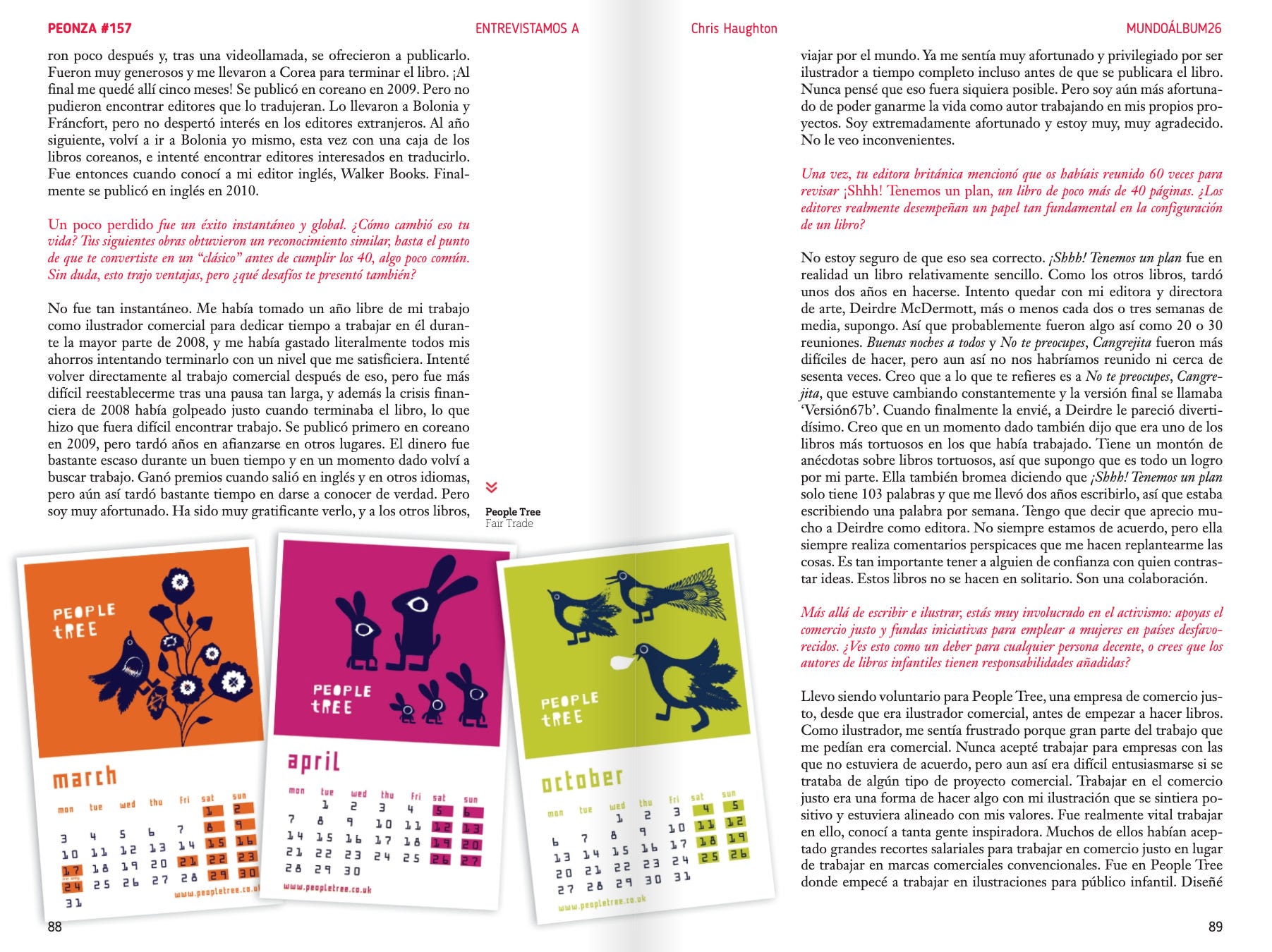
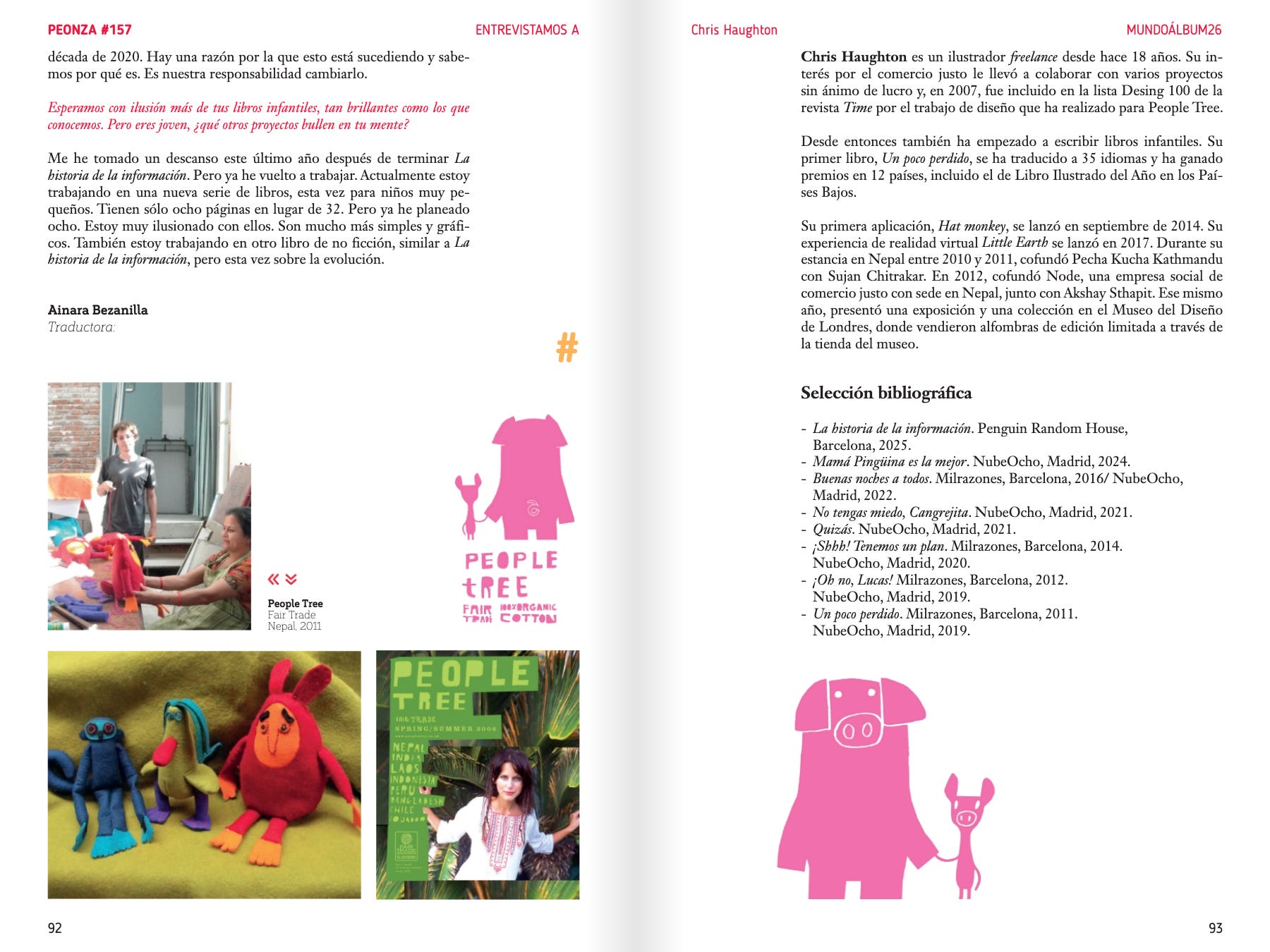
I have been volunteering for People Tree, a fair trade company, during the time I was a commercial illustrator before I began making books. As an illustrator I had felt frustrated that much of the work I was being asked to do was commercial. I never agreed to work for companies that I didn’t agree with, but even still it was hard to get excited if it was some sort of commercial project. Working in fair trade was a way to do something with my illustration that felt positive that aligned with my values. It was really life affirming to work on, I have met so many inspiring people. Many of whom had taken large pay cuts to work in fair trade rather than working in commercial high street brands. It was at People Tree that I first started working on illustrations for children. I designed a line of t-shirts for them in 2006. These were successful and I was asked back to do more and more and I also started working with other fair trade and eco brands. I haven’t been working with fair trade as much as I would like to over the last few years but I think the publishing industry is similar in many respects. The people I have worked with in this industry do it because they are passionate about the work they are doing, money is not the driving force. The people around me are first and foremost passionate about books and children and making positive changes in the world.
What do you think can be learned in countries like Nepal that can’t be learned in the West?
Well its hard to answer that in a satisfying way without doing a lot of generalising. Which I dont think is fair to do. I spent around six months in Nepal and another six months in India. Through my fair trade connections I was very lucky to meet many really fascinating and inspiring people. I met so many Nepalis from very different backgrounds each with their own perspectives and they don’t fit in any box. One thing that is certainly unique in places like Kathmandu is that people have seen more change in their city in their lifetime than anyone in the West can even imagine. And that dynamism is fascinating because you can make a lot of change and set things up much, much more easily than here. Everyone I met was politically active. Satyendra Khadgi and his family created the fair trade project I am lucky to be connected to. Their family has a fascinating history, Satyendra’s grandfather was a radical politician from the lowest caste. Their home is a bustling community hub, they set up a school for disadvantaged children and over the years took on more and more children. When I was there they had 19 orphans living in their own home. This is all alongside employing hundreds of disadvantaged adults at their fair trade project.
I taught illustration at Kathmandu University with artist Sujan Chitrakar and we became great friends. We set up a series of evening talks ‘Pecha Kucha Night’ in Kathmandu together afterwards. That was a roaring success and is still ongoing I think. I am very proud of that.
I set up my fair trade rug business with another friend, Akshay Sthapit, who works on IT projects and creates start ups in Nepal. NayanTara Gurung Kakshapati is another friend, she is a photographer and when she was around 30 years old she and her colleagues realised that some of Nepal’s important documentary photographs were being lost as there was no photographic archive in the country. So she set it up herself. I was astonished that someone so young could set up a national archive. I do wish people here in the West took more of an active role in things like the Nepalis I met do. I think in the West we place far too much trust in our institutions. We shouldn’t. If we dont shape things ourselves it will be shaped without us, in a way that you are not going to want. As the saying goes “The price of liberty is eternal vigilance.”
Like many creators, you view AI as a significant threat and advocate for protecting intellectual property. How do you foresee the immediate future in this regard?
I really dont know. I really wish more people were active and vocal in this. If we dont come together and protect our copyright we are going to lose it entirely. I wrote about this in my book THE HISTORY OF INFORMATION. These companies have been illegally using our work to train AI without any permission or payment. Now, in the US and UK and elsewhere, they are lobbying governments to change our laws to make this legal. All the content has been made by you and me, yet they are taking it and using it against us for profit. This is exactly the same as what has been happening to social media. All our input, our likes, our comments, our location data is harvested. We have given it away for free and it is then sold for billions. We never signed up to this. And we never would agreed to this situation if it was proposed to us at the start. We need to take control of our data and use it for ourselves rather than handing it all over to Big Tech. Cory Doctorow and others have been campaigning about this for years. We have seen our world go from the positive, utopian outlook it had in the 90s to the negative dystopian one we are seeing today in the 2020s. There is a reason this is happening and we know why it is. It is our responsibility to change it.
We eagerly await more of your children’s books, as brilliant as the ones we know. But you’re young—what other projects are brewing in your mind?
I have been taking a break for this last year after finishing THE HISTORY OF INFORMATION. But I have resumed work now. I’m currently working on a new set of books, this time for very young children. They are only eight pages instead of 32. But I have planned out eight of them already. Im very excited about them. They are much more simple and graphic. I am also working on another non-fiction book, similar to THE HISTORY OF INFORMATION but this time about evolution.
THE HISTORY OF INFORMATION has been translated into spanish and other languages.
Thanks for this! It's reassuring to learn of the timelines of these books and inspiring to read about your dedication, practice, career, choices and values around the work. Can't wait to see the new books as well as the one about evolution!
That statistic puts even Albert Cossery to shame, with his average of one sentence a day. Although I suspect you’re far more productive than he is. (Which is, obviously, unforgivable 😂)